Arlen Chase, a distinguished Maya archaeologist, educator and lifelong supporter of Stevenson, will receive the Stevenson Alumni Association’s Merle Greene Robertson Award for Contributions to Society.
Established in 2003, the award recognizes alumni whose service and achievements embody the spirit of Stevenson while contributing meaningfully to society. It is named in honor of pioneering Mesoamerican archaeologist Merle Greene Robertson, who taught at Stevenson from 1968 to 1977 and became known internationally for her work documenting Maya art and inscriptions. A champion of experiential education long before it became commonplace, Robertson shaped the course of Stevenson by immersing students in hands-on learning, including archaeological expeditions throughout the Yucatán Peninsula.
For Chase, receiving an award bearing Robertson’s name carries especially deep meaning.
“I was a student of Merle Greene Robertson; without her guidance and input I would never have undertaken a career in Mesoamerican and Maya archaeology,” he said. “She was truly a hidden gem among the RLS faculty.”
Chase recalls Robertson as both an inspiring scholar and an extraordinarily generous mentor. She opened her apartment on campus to students at all hours so they could use her extensive personal library, often hosting informal classes over cups of drip coffee. Beyond Stevenson, she welcomed students into her home in Palenque, Mexico, sharing not only her knowledge but also meals, resources and opportunities for field experience.
“She engaged students in her research by taking them into the field and jungle and mentored them after they left RLS,” Chase said. “This is something that I have attempted to do with the university students who have joined me in the field at Caracol, Belize for the last 40 years.”
That mentorship launched a career that has spanned more than five decades and helped reshape modern understanding of the ancient Maya world.
After graduating from Stevenson in 1971, Chase attended the University of Pennsylvania, then considered the leading institution for Maya archaeology due to its groundbreaking excavations at Tikal, Guatemala – a project in which Robertson herself had participated. While at Penn, Chase gained archaeological field experience nearly every summer, working at sites across Guatemala, the American Southwest and Pennsylvania.
Following graduation in 1975, Chase and his wife, fellow archaeologist Diane Chase, embarked on a professional partnership that would define their lives’ work. After early projects in Guatemala and Nicaragua, the couple moved to Belize in 1978 at the invitation of the country’s archaeological commissioner. There, they conducted excavations at Nohmul and Santa Rita Corozal before beginning work in 1985 at Caracol, Belize, one of the largest and most significant ancient Maya cities ever discovered.
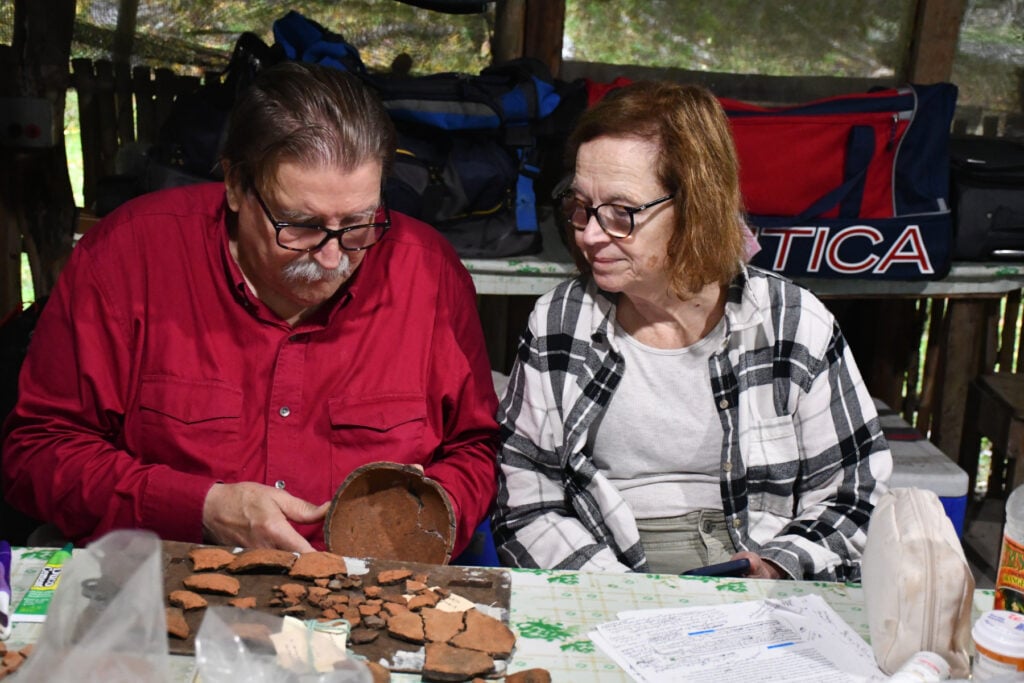
The Chases have now led research at Caracol for more than 40 years and are planning their 41st field season in 2027.
In parallel with their fieldwork, both built accomplished academic careers. Chase began teaching at the University of Central Florida in 1984, eventually becoming the university’s first chair of anthropology and later serving in multiple administrative leadership roles. Over the years, the couple also held positions at the University of Nevada, Las Vegas and within the Claremont Colleges system before moving in 2023 to the University of Houston, where Chase now serves as Professor and Chair of Anthropology and Comparative Studies.
Despite his international reputation, Chase remains deeply connected to Stevenson and especially to the Class of 1971.
“As an individual who was at RLS during his entire high school journey, the members of the Class of 1971 became a second family to me,” he said.
He remembers Stevenson during a transformative cultural moment shaped by the counterculture movement of nearby San Francisco and the ongoing Vietnam War. Among his favorite memories are organizing weekend camping trips to Arroyo Seco and Big Sur, where classmates bonded over outdoor adventures and barbecued steaks, as well as trips to the Fillmore West for concerts in San Francisco.
During his student years, Chase also edited an underground student newspaper called the “F.R.I.G.A.T.E.,” inspired by the Berkeley Barb and the spirit of student expression of the era.
The bonds formed during those years remain strong today. Chase credits classmates such as Allen “Skip” Olinger ’71, Robert Kasavan ’71, Mike Morel ’71 and Kevin McNeely ’71 for maintaining close ties through decades of friendship, visits to archaeological sites in Belize and continued support of his research. In one memorable example, members of the Class of 1971 rallied together during an Archaeology Magazine competition, helping propel Caracol to the finals against some of the world’s most famous archaeological sites.
Looking ahead, Chase remains focused on preserving and expanding access to Caracol while continuing to advance Maya scholarship. He is currently collaborating with the Belize Institute of Archaeology on excavation and preservation efforts at the site, including stabilization projects supported by the U.S. Ambassador’s Fund and other international partnerships.
He and his colleagues are also preparing two major publications expected in 2027 and 2028: a comprehensive volume on the archaeology of Belize and a sweeping synthesis of more than four decades of research at Caracol that places the site within the broader history of Maya civilization.
For Stevenson, Chase’s life and work stand as a powerful reflection of the values embodied by the Merle Greene Robertson Award: intellectual curiosity, mentorship, global engagement and the transformative impact of experiential education.